Have you ever received a message that simply says “WSP?” and wondered what the sender means? You might see these three letters in text messages, Instagram DMs, Snapchat chats, TikTok comments, or WhatsApp conversations. Although WSP looks like a random combination of letters, it has a simple meaning in everyday digital communication.
Texting abbreviations make conversations faster and more convenient. Instead of typing complete sentences, people use short expressions to communicate their thoughts. WSP is one of those popular shortcuts, especially among friends and people who regularly communicate online.
However, its meaning can change slightly depending on the conversation, punctuation, and relationship between the sender and receiver. Understanding the context can help you respond naturally without misunderstanding the message.
What Does WSP Mean in Text?
WSP means “What’s Up?” in text messages and online conversations. It is an informal abbreviation people use to greet someone, ask how they are doing, or find out what they are currently doing. It is a quick, friendly way to start a conversation without typing the complete phrase.
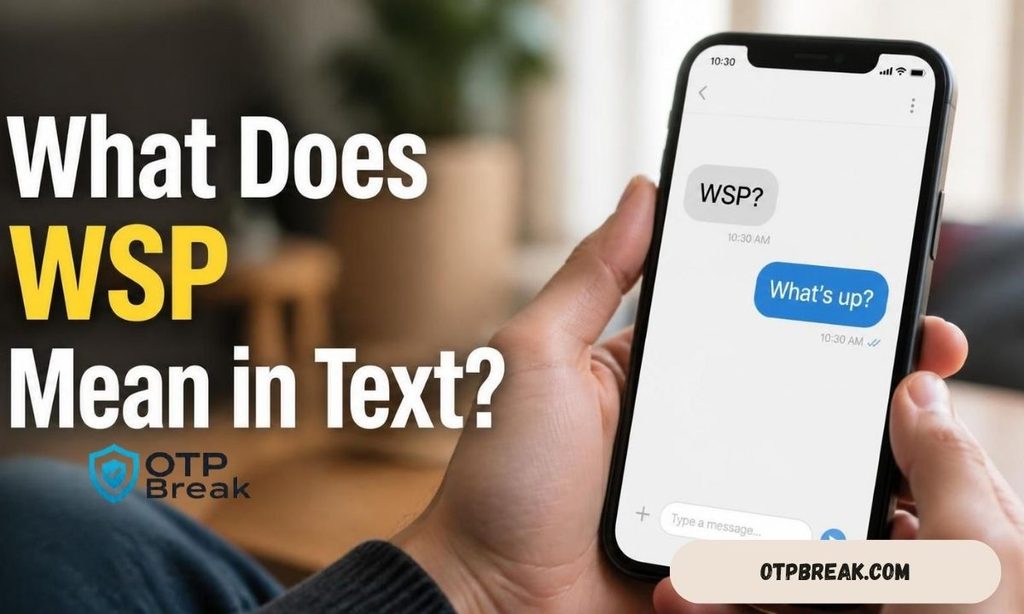
For example:
- Person 1: WSP?
- Person 2: Not much, just relaxing. You?
In this conversation, the sender is simply checking in and opening the door for a friendly chat.
The abbreviation is generally casual and does not carry a negative meaning. It can be used between friends, classmates, family members, and online acquaintances.
WSP Meaning at a Glance
Here is a quick overview of the abbreviation and its common uses.
| Category | Explanation |
|---|---|
| Abbreviation | WSP |
| Full form | What’s Up? |
| Category | Texting slang |
| Meaning | Hello, how are you, or what’s happening? |
| Tone | Friendly and casual |
| Common platforms | Snapchat, Instagram, TikTok, WhatsApp |
| Typical audience | Friends and online acquaintances |
| Formality | Informal |
| Common reply | Not much, you? |
The most important thing to remember is that WSP usually works as a greeting. The sender might not expect a detailed explanation. Sometimes, they simply want to start talking.
Where Did WSP Come From?
WSP developed as part of internet and mobile texting culture. People have shortened everyday expressions for decades to make digital conversations quicker and easier.
The phrase “What’s Up?” was already a familiar greeting in spoken English. As text messaging became more popular, users started creating shorter versions of common expressions.
WSP follows this casual abbreviation style. It removes most of the vowels and keeps the letters that make the original phrase recognizable.
The expression became useful in several forms of online communication, including:
- Traditional SMS messages.
- Instant messaging applications.
- Social media direct messages.
- Online gaming conversations.
- Internet forums and group chats.
Its continued use shows how familiar expressions can become permanent parts of digital language.
Today, people can send WSP in seconds without worrying about spelling out an entire greeting.
Read Now : What Does HY Mean in Text
How Is WSP Used in Everyday Conversations?
WSP is flexible. Although its primary meaning is “What’s Up?”, people use it in several situations.
Here are the most common ways it appears in everyday communication.
1. As a Friendly Greeting
The simplest use of WSP is saying hello to someone.
For example:
- Alex: WSP bro?
- Daniel: Hey! Nothing much.
Here, Alex is not asking a complicated question. He is simply greeting his friend.
2. To Ask What Someone Is Doing
Sometimes, WSP means “What are you doing?” or “What are you up to?”
For example:
- Sarah: WSP?
- Emma: Just watching a movie.
In this situation, Sarah wants to know what Emma is doing at that moment.
3. To Start a New Conversation
People often send WSP when they want to talk but do not have a particular subject in mind.
For example:
- Mike: Hey, wsp?
- Chris: Nothing special. What’s going on?
It creates an easy opportunity to continue chatting.
4. To Check on Someone
WSP can also be a simple way to check how someone is feeling.
For example:
- Jake: WSP? Haven’t heard from you lately.
- Ryan: I’m good, just been busy with work.
The sender may be showing interest or trying to reconnect.
5. To Ask About Plans
When someone adds a time or event, WSP can become a question about plans.
For example:
- Person 1: WSP tonight?
- Person 2: Nothing planned yet. Why?
The sender may want to know whether the other person is available.
What Does WSP Mean on Different Social Media Platforms?
The basic meaning usually stays the same across social media platforms. However, the situation in which someone uses it can vary.
WSP Meaning on Snapchat
On Snapchat, WSP generally means “What’s Up?” People use it to start conversations, respond to stories, or check whether someone is available to chat.
For example:
- You: WSP?
- Friend: Just chilling. Send me a snap!
It can also be used when someone wants to restart a conversation after not talking for a while.
WSP Meaning on Instagram
On Instagram, WSP is commonly used in direct messages. Someone might send it after following your account, replying to your story, or wanting to get to know you.
For example:
- Person 1: Hey, wsp?
- Person 2: Nothing much. Just scrolling.
It is a relaxed way to begin a conversation without making the first message complicated.
WSP Meaning on WhatsApp
On WhatsApp, WSP usually works as a casual greeting in private messages and group chats.
For example:
- Friend: WSP everyone?
- You: All good here. What’s happening?
In some conversations, WSP may also refer to WhatsApp itself. The surrounding sentence helps determine which meaning the sender intends.
WSP Meaning on TikTok
On TikTok, people may use WSP in comments, direct messages, and conversations with mutual followers.
For example:
- Person 1: WSP?
- Person 2: Just watching videos!
It is useful when someone wants to begin a casual conversation after interacting with another person’s content.
WSP Meaning in Gaming Chats
Gamers also use WSP when communicating through multiplayer games, Discord, and other online communities.
For example:
- Player 1: WSP guys?
- Player 2: Getting ready for another match.
In gaming conversations, it may mean hello, what’s happening, or what everyone is doing.
How to Reply to WSP in a Text Message
If someone sends you WSP, there is no need to overthink your response. A short and natural answer is usually enough.
Your reply can depend on your mood, relationship with the sender, and what you are doing.
Here are some useful responses.
| Your Situation | Suggested Reply |
|---|---|
| You are relaxing | Not much, just chilling. You? |
| You are busy | Just working right now. |
| You are happy | Everything is good! |
| You want to talk | Hey! What’s going on? |
| You are studying | Just studying for an exam. |
| You are bored | Nothing much. I’m bored! |
| You want to make plans | Nothing planned. What’s up? |
| You have exciting news | A lot! I have something to tell you. |
| You have not talked recently | Hey! It’s been a while. |
| You are gaming | Just playing a game. |
The best response is one that feels natural rather than forced.
Is WSP Different From WSG and WYD?
WSP, WSG, and WYD may look similar because people use all three in casual digital conversations. However, they have slightly different meanings.
Understanding these abbreviations can help you avoid confusion when chatting with friends.
| Slang | Full Form | Meaning |
|---|---|---|
| WSP | What’s Up? | Asking what’s happening |
| WSG | What’s Good? | Asking how things are going |
| WYD | What You Doing? | Asking about someone’s current activity |
| HRU | How Are You? | Asking about someone’s well-being |
| HBU | How About You? | Returning a question |
| WBU | What About You? | Asking for the other person’s opinion or update |
| SUP | What’s Up? | A shortened casual greeting |
| NM | Not Much | Saying nothing special is happening |
| LMK | Let Me Know | Asking someone to provide information |
WSP vs. WSG
WSP means “What’s Up?” while WSG means “What’s Good?”
Both are casual greetings, but WSG often sounds like someone is asking how things are going or whether anything good is happening.
For example:
- WSP? What’s happening?
- WSG? How are things?
WSP vs. WYD
WSP is a general greeting or conversation starter. WYD specifically asks what someone is doing.
For example:
- WSP? Hey, how’s everything?
- WYD? Are you studying or relaxing?
Although their meanings overlap in some conversations, they are not exactly interchangeable.
WSP vs. SUP
SUP is another shortened form of “What’s Up?”
Both expressions can be used to greet someone informally. The main difference is their spelling and texting style.
For example:
- WSP bro?
- Sup bro?
Both communicate a similar friendly message.
Does WSP Have Other Meanings?
Yes. Although “What’s Up?” is the most common meaning in everyday texting, WSP can represent other expressions in different situations.
You should consider the subject of the conversation before deciding what the abbreviation means.
Here are some alternative meanings.
1. WhatsApp
In some conversations, WSP may be used as a shortened reference to WhatsApp, the popular messaging application.
For example:
“Send me the details on WSP.”
In this sentence, the person may be referring to the messaging platform rather than asking what’s happening.
2. White Skin Privilege
WSP can also stand for “White Skin Privilege” in discussions about race, society, history, and inequality.
This meaning is completely different from the casual greeting.
For example:
“The discussion focused on WSP and its social implications.”
Here, the surrounding topic makes the intended meaning clearer.
3. Washington State Patrol
In American news, public safety discussions, or law enforcement contexts, WSP can refer to the Washington State Patrol.
For example:
“The WSP issued a traffic safety announcement.”
This usage is related to an official organization rather than texting slang.
4. Wisconsin State Patrol
WSP may also refer to the Wisconsin State Patrol in regional news or public safety information.
The correct interpretation depends on the location and subject being discussed.
5. WSP Global
WSP can also refer to WSP Global, an international professional services firm known for engineering, consulting, and related services.
You may encounter this meaning in business, construction, infrastructure, and engineering discussions.
Important: Do not assume every use of WSP has the same meaning. In personal messages, “What’s Up?” is generally the most likely interpretation. In professional or specialized discussions, look at the surrounding subject.
What Does WSP Mean From a Guy?
If a guy sends you WSP, he is usually asking what’s happening or trying to start a conversation.
It does not automatically mean he is romantically interested in you.
His intention depends on your relationship, previous conversations, and the way he communicates.
Here are some possible situations:
- He is starting a conversation: He wants to talk but does not have a specific topic.
- He is checking on you: He wants to know how you are doing.
- He is interested in your plans: He may want to know whether you are available.
- He is reconnecting: He might be trying to restart communication after some time.
For example:
- Him: Hey, wsp?
- You: Not much. What’s up?
- Him: Just wanted to talk to you.
In this situation, he is using a casual greeting to open a conversation.
However, one short message is not enough to determine someone’s feelings. Pay attention to how consistently he communicates and whether he shows genuine interest.
What Does WSP Mean From a Girl?
When a girl sends WSP, it generally means the same thing: “What’s Up?”
She may want to say hello, check on you, or find out what you are doing.
For example:
- Her: WSP?
- You: Just relaxing. What about you?
- Her: Same, I’m bored.
This is a normal, casual conversation.
Sometimes, she might use WSP to create an opportunity to talk or make plans. However, the abbreviation itself does not confirm romantic interest.
Consider the complete conversation instead of interpreting three letters on their own.
Is WSP Flirty or Romantic?
WSP is not naturally a flirty expression. Its primary purpose is to start a casual conversation.
However, it can appear in romantic conversations when someone uses it to contact a person they like.
For example:
- “Heyyy wsp? 😊”
- “Wsp, I was thinking about you.”
- “WSP tonight? Wanna hang out?”
These messages may sound more personal because of the additional words and emojis.
Here are a few clues that can help you understand the sender’s intention:
- Previous conversations: Have you already been flirting or showing interest?
- Message frequency: Does the person regularly try to contact you?
- Additional wording: Do they use compliments or affectionate expressions?
- Conversation length: Do they make an effort to keep talking?
- Plans: Do they suggest meeting or spending time together?
Remember that WSP alone is not a romantic signal. The surrounding communication matters much more.
Is WSP Rude or Disrespectful?
No. WSP is generally not rude, offensive, or disrespectful.
It is simply an informal abbreviation used in everyday digital communication.
However, some people might consider it too short or casual, particularly when communicating with someone they do not know well.
For example:
- To a close friend: WSP bro?
- To a teacher: Hello, how are you today?
- To a manager: Hi, I hope you’re doing well.
The important difference is the level of formality.
A short message is not automatically disrespectful. It depends on the relationship, communication style, and situation.
Is WSP Appropriate for Professional Conversations?
WSP is generally unsuitable for formal communication.
You should avoid using it in professional emails, job applications, official requests, and business messages.
Professional communication usually benefits from complete sentences and clear greetings.
Consider these examples:
| Informal Message | Professional Alternative |
|---|---|
| WSP? | Hello, how are you? |
| WSP with the project? | Could you share an update on the project? |
| WSP today? | How is your schedule looking today? |
| WSP bro? | Hi, hope you’re doing well. |
You can use WSP with coworkers if you already have a relaxed communication style. However, when speaking with clients, supervisors, or unfamiliar colleagues, a complete greeting is safer.
Does Capitalization Change the Meaning of WSP?
No. Capitalization usually does not change the meaning of this texting abbreviation.
You may see it written in several ways:
- WSP
- Wsp
- wsp
- Wsp?
- wsp bro
- Hey, WSP?
All these variations generally communicate “What’s Up?”
The difference is mostly stylistic.
For example, some people prefer lowercase messages because they look relaxed and natural. Others use capital letters because of their typing habits.
Punctuation can also affect how a message feels, but it does not necessarily change its basic meaning.
How to Use WSP Naturally in Your Own Messages
If you want to use WSP in your conversations, keep it simple.
Here are five practical tips:
- Use it with familiar people: Friends and casual online acquaintances are the best audience.
- Keep the situation informal: Avoid using it in serious professional communication.
- Add a name when helpful: “WSP, Alex?” sounds more personal.
- Use emojis naturally: A smile or friendly emoji can make the greeting feel warmer.
- Continue the conversation: Add another question if you want to keep chatting.
For example, instead of sending only “WSP,” you could write:
“Hey, wsp? How’s your day going?”
This gives the other person more opportunities to respond.
Why Is WSP Still Used in 2026?
Digital communication continues to evolve, but familiar abbreviations remain useful because they are quick, recognizable, and easy to understand.
In 2026, people communicate through multiple channels, including private messages, group chats, social media comments, and gaming communities.
WSP fits naturally into these environments.
Several reasons explain its continued use:
- Speed: It takes less time to type than the complete phrase.
- Convenience: It works in short messages and quick replies.
- Familiarity: Many internet users recognize the abbreviation.
- Informal tone: It makes conversations feel relaxed.
- Platform flexibility: It can be used across different messaging services.
There has not been a major change in its established texting meaning. Its continued use across social media spaces and digital communities reflects the popularity of short, convenient expressions.
One important point for 2026 is that abbreviations can have different meanings depending on the platform and subject. Context remains essential when interpreting short messages.
Frequently Asked Questions About WSP Meaning in Text
1. What does WSP mean in a text message?
WSP means “What’s Up?” It is a casual abbreviation used to greet someone, ask how they are doing, or find out what they are currently doing.
2. What does WSP mean on Snapchat?
On Snapchat, WSP usually means “What’s Up?” People use it to start conversations, reply to snaps, or check whether someone is available to chat.
3. What does WSP mean on Instagram?
On Instagram, WSP is a casual greeting commonly used in direct messages. It helps people start conversations with friends, followers, and new acquaintances.
4. What does WSP mean on WhatsApp?
WSP generally means “What’s Up?” on WhatsApp. However, it can sometimes refer to the WhatsApp application itself, depending on the sentence.
5. What does WSP mean from a guy?
When a guy sends WSP, he is usually greeting you or asking what you are doing. It can be a conversation starter, but it does not automatically indicate romantic interest.
6. What does WSP mean from a girl?
When a girl texts WSP, she generally means “What’s Up?” She might be checking on you, starting a conversation, or asking what you are doing.
7. Is WSP the same as WYD?
No. WSP means “What’s Up?” while WYD means “What You Doing?” WSP is a general greeting, whereas WYD specifically asks about someone’s current activity.
8. What is the best reply to WSP?
A simple response is “Not much, you?” Other options include “Just chilling,” “I’m doing great,” or “What’s going on?”
9. Does WSP mean WhatsApp?
Sometimes. In certain conversations, WSP can be shorthand for WhatsApp. However, its most common meaning in casual texting is “What’s Up?”
10. Is WSP a slang word?
Yes. WSP is an informal texting abbreviation and internet slang expression. People commonly use it in social media messages, private chats, and online conversations.
11. Can I use WSP with someone I don’t know?
You can, but it may sound overly casual. If you are contacting someone for the first time, a friendly greeting such as “Hi, how are you?” may be more appropriate.
12. Does WSP have a negative meaning?
No. In ordinary texting, WSP is generally friendly and harmless. Other meanings exist in specialized contexts, but the abbreviation is not inherently offensive.
13. What does WSP mean without a question mark?
It usually means “What’s Up?” even without punctuation. However, in expressions such as “That’s WSP,” it can mean “That’s what’s up,” showing approval or agreement.
14. What does WSP mean in gaming?
In gaming conversations, WSP usually means “What’s Up?” Players use it to greet teammates, start discussions, or ask what other players are doing.
15. Is WSP still popular in 2026?
Yes. WSP remains a recognizable texting abbreviation in casual digital communication. Its simple spelling and friendly meaning make it useful across messaging platforms and online communities.
Conclusion
Understanding the WSP meaning in text is simple once you know its most common definition. WSP stands for “What’s Up?” and works as a friendly greeting, conversation starter, or quick way to check on someone.
You can use it on Snapchat, Instagram, WhatsApp, TikTok, and other messaging platforms. Although it has alternative meanings in professional and specialized discussions, the casual greeting is usually the intended meaning in personal messages.
The next time someone texts you WSP, you can confidently respond with “Not much, you?” and keep the conversation going naturally.

David is the creator and author behind Healthy Leeks, a platform focused on grammar, writing skills, and English language learning. Passionate about clear communication and effective writing, David shares practical grammar tips, easy-to-follow language guides, and educational content to help readers improve their English with confidence.