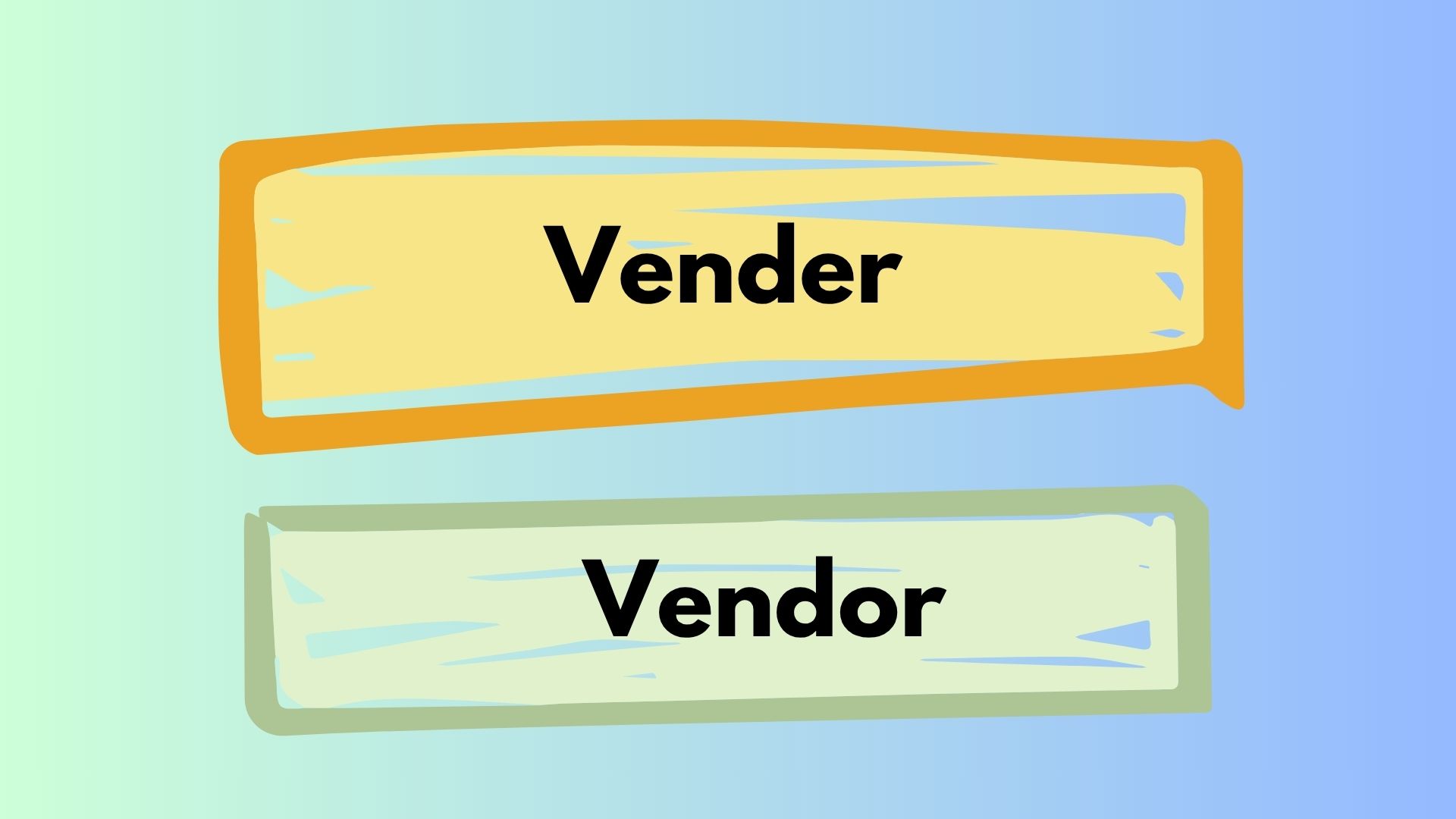
Every week I see the same question pop up in emails, group chats, and comment sections: is it vender or vendor? I’ve spent years editing business copy, and I still catch writers second-guessing this one. So I decided to settle it for good with dictionary sources, real-world examples, and a few memory tricks I use myself.
Short answer: vendor is the correct, standard spelling in modern English. Vender exists, but it’s rare, dated, and mostly limited to a handful of stylistic holdouts. Below, I’ll walk through exactly why vendor wins, when vender still shows up, and how to never mix them up again.
Why I Found “Vendor” is the Only Correct Spelling
When I first researched this, I expected a messy British-versus-American split, like “colour” and “color.” That’s not what’s happening here. Vendor is simply the standard spelling everywhere English is written in the US, the UK, Canada, Australia, and everywhere business English is taught. Vender is listed in dictionaries only as a minor, less common variant, not as a regional or historical alternative.
The word traces back to Anglo-French “vendour,” itself rooted in “vendre,” meaning “to sell.” That “-or” ending is consistent with dozens of other agent nouns in English actor, editor, director, creator. Vendor fits the pattern; vender breaks it.
The Simple Rule I Use
Here’s the rule I give every writer I mentor: if the word ends in “-or” and describes someone who does something (sells, acts, directs, edits), default to “-or.” When in doubt, type “vendor” it will be correct roughly 99% of the time in any professional, academic, or everyday context.
My Definition and Meaning Analysis
What is a Vendor?
A vendor is a person, business, or entity that sells goods or services to another party. Merriam-Webster keeps the definition refreshingly simple: one who vends, meaning one who sells. That single-word root, “vend,” is where both “vendor” and “vending machine” come from.
Common Types of Vendors
- Software vendor — a company that licenses or sells software products
- Street vendor — an individual selling goods from a stall or cart in public
- Food vendor — a business or person selling meals, snacks, or drinks at events
- Wholesale vendor — a supplier selling goods in bulk to retailers
- Event vendor — any business contracted to provide services at a wedding, conference, or festival
The Complete Comparison: Vendor vs Vender
The vendor vs vender debate isn’t really a debate once you look at usage data and dictionary treatment side by side.
| Feature | Vendor | Vender |
| Status | Standard, preferred spelling | Rare, less common variant |
| Dictionary listing | Main entry | Listed as a variant of vendor |
| Business & legal writing | Required standard | Considered incorrect by most style guides |
| Historical use | Common since 1594 | Appears in older literary texts |
| Modern frequency | Overwhelmingly dominant | Extremely rare, mostly stylistic |
The New Yorker Exception
If you’ve ever spotted “vender” in a polished, professionally edited publication, it was probably The New Yorker. The magazine is famous for keeping a handful of old-fashioned spellings as part of its house style, and vender is one of them. It’s a deliberate editorial choice, not a sign that the spelling is gaining ground elsewhere nearly every other newspaper, journal, and style guide sticks with vendor.
Common Myths I Discovered
Myth #1: “Vender is the British spelling”
This is the myth I hear most often, and it’s simply not true. British English uses vendor exactly the same way American English does. There’s no US/UK split here vendor is standard on both sides of the Atlantic.
Myth #2: “Both spellings are acceptable”
Technically, dictionaries acknowledge vender exists, but “acknowledged” isn’t the same as “acceptable” in professional writing. In contracts, resumes, marketing copy, and academic papers, vendor is the only spelling most editors and style guides will approve.
Myth #3: “It doesn’t matter which one you use”
It does matter, especially in business documents. Using “vender” in a formal proposal or legal agreement can read as a typo, which chips away at credibility even if the meaning is technically clear.
Real-World Examples I Found
Business Context
“Our procurement team is finalizing a contract with a new software vendor this quarter.”
Everyday Context
“I bought fresh mangoes from a street vendor near the market this morning.”
Event Context
“The wedding planner confirmed all vendors florist, caterer, and photographer for Saturday.”
Tech Context
“The IT department is evaluating three cloud vendors before renewing the contract.”
My Memory Tricks to Remember

Trick #1: The Vending Machine Connection
A vending machine sells things, and it’s spelled with an “o” pattern in mind vend, vendor, vending. Anchor “vendor” to “vending machine” and the correct spelling sticks.
Trick #2: “O” for Official
Official business documents use vendor. Remember: “O” for official, “O” for vendor.
Trick #4: The Sell-O Connection
Vendor sells. Both words share that round “o” sound near the end sell-or, vend-or. Let the rhyme guide your spelling.
Trick #3: No “E” in Error-Free Writing
If you want error-free writing, skip the “e” vendor has no extra “e” where vender puts one. Fewer errors, fewer “e”s.
Read More: Is “Good Morning” One Word? I Found the Definitive Answer
Vendor vs Vender: My Summary Table
| Question | Answer |
| Which spelling should I use? | Vendor, in nearly every context |
| Is vender wrong? | Not wrong, just rare and outdated |
| Does region matter? | No — vendor is standard in US and UK English |
| Any well-known exception? | The New Yorker’s house style |
| Best for legal/business writing? | Vendor, always |
Related Words I Explored
- Vendee — the buyer in a sale, paired with vendor as the seller
- Vend — the root verb meaning to sell
- Vending — the act of selling, especially via machines
- Vendible — capable of being sold
- Seller, merchant, trader, retailer, wholesaler, hawker — common synonyms for vendor
Quick Test I Created
- The company signed a new software ______ (vendor/vender) agreement.
- A street ______ (vendor/vender) sold roasted corn near the station.
- Except for a few stylistic holdouts, nearly every publication prefers ______ (vendor/vender).
Answer: vendor, vendor, vendor in every case.
Explore More Grammar Guides
For more spelling and word-choice breakdowns like this one, keep browsing our grammar and vocabulary guides I regularly cover commonly confused word pairs, style-guide rules, and quick tricks to keep your writing polished.
Read More: Time Flies or Time Flys? I Found the Definitive Answer
Frequently Asked Questions
Is “vender” a real word, or just a misspelling of “vendor”?
Yes, it’s a real word, but it’s a rare variant rather than an error dictionaries list vender as a less common form of vendor.
What does “vendor” mean?
A vendor is simply a seller one who vends goods or services to others.
Which spelling should I use in business writing?
Use vendor. It’s the standard, more frequent spelling for business, services, and formal contexts.
Is “vender” the British spelling of “vendor”?
No that’s a myth. Both American and British English use vendor as the standard spelling.
Does The New Yorker really spell it “vender”?
Yes, it’s a well-known house-style choice, even though vender is rare in modern English overall.
What’s the difference between a vendor and a vendee?
A vendor is the seller and a vendee is the buyer they’re paired terms in a sale or contract.
What is a street vendor/vender?
It’s a person who sells goods in a public place, such as a street, market, or outdoor event.
Where did the word “vendor” come from?
It comes from Anglo-French “vendour,” rooted in “vendre” (to sell), with its first known use dating to 1594.
Is “vendor” used in legal writing too?
Ye legal dictionaries define a vendor as one that sells something, and even note vender as an accepted variant.
What are synonyms for “vendor”?
Common synonyms include seller, merchant, trader, retailer, wholesaler, and hawker for a mobile street seller.
Final Thought
When you’re stuck choosing between vender or vendor, trust the standard: vendor wins in business, legal, academic, and everyday writing alike. Save vender for trivia night or a New Yorker deep-dive, and let vendor carry your everyday work.

David is the creator and author behind Healthy Leeks, a platform focused on grammar, writing skills, and English language learning. Passionate about clear communication and effective writing, David shares practical grammar tips, easy-to-follow language guides, and educational content to help readers improve their English with confidence.